Sunday, August 23, 2015

Swearing In

July 29, 2015 was a day of anticipation, emotion and new beginnings.  After eight weeks of intense language, COD (Community and Organizational Development) and PC training, we were ready to take the next step from PC trainee to PC volunteer.

Early that morning we said goodbye to our initial host families and loaded all our stuff onto rutiere in our training villages for the trip to Chisinau.  As befitting the occasion our attire was not the casual or even business casual we had worn since our arrival.  We brought out the good clothes we had all packed more than eight weeks ago in the US for this special occasion. We were definitely dressed up. And from my perspective, we cleaned up pretty well and looked like one fine group of Americans. 

As we waited for all thirty one COD and SED volunteers who were to be sworn in arrive as well as the staff and guests, a few of us went to a nearby flower stand to purchase bouquets for our Language Training Instructors (LTIs) and COD Program Manager and Program Specialist. Without them this day would not have been possible and we would not be ready to embark upon our service.

In Milesti Mici we had two LTIs who were and are excellent language teachers.  They were always encouraging, patient and supportive as we struggled to comprehend much material in a limited period of time. They tirelessly worked on our pronunciation, verb conjugations and vocabulary.  They were creative in their presentations and the exercises we did in class.  Four hours of language class six days per week was a lot of work for us, and even more work for them because of all of the hours of preparation before and after class.  Their weekly evaluations and feedback helped us to focus on our language learning. Because of their efforts we were able to understand and communicate in Romanian sufficiently enough to pass the language assessment that was a prerequisite to our being sworn in.  In addition to teaching us Romanian, they answered our questions and shared with us about the culture, life and people of Moldova.

Similarly, our COD Program Manager and Program Specialist were and are the best PC program directors in Moldova. Their presentations were efficient, organized and thought provoking evidencing careful planning and preparation.  The exercises in which we engaged were real learning experiences designed to both challenge us and assist us in our future work, The information and materials they provided are helpful and useful resources to have available for reference as questions and situations arise. More importantly perhaps, they quickly got to know each of us and took an interest in us as individuals with different backgrounds, experiences and skills. That interest and knowledge were certainly factors as they determined our permanent assignments. They probably spent countless hours considering and matching us with partners and assignments so as to insure our success. They remain ready and willing to provide assistance and guidance as we work with our partners and communities.

Before the ceremony began, we presented our bouquets and thanks individually to each of our LTIs and COD program managers.  They seemed touched by our gesture.  It was a simple offering, but represented true appreciation, gratitude and respect for the work of four very special ladies.

The ceremony was held in one of the large classrooms where we had many of our PC training classes. It was filled to capacity with PC staff, our future work partners and host families, and invited guests. PC Acting Country Director for Moldova Meredith Dalton and the Charge d'Affaires Ambassador Martha Campbell from the US Embassy in Moldova presided.  Two M29 volunteers dressed in traditional Moldovan costumes served as masters of ceremony. To our surprise the local Moldovan media turned out in full force and television cameras and microphones were everywhere. The importance and significance of this day was brought home to all and definitely not lost on any of us.

At the front of the room stood the American, Peace Corps and Moldovan flags. The ceremony began with the playing of the national anthems of Moldova and the United States.  As the first notes of the Star Spangled Banner played out, we Americans placed a hand over our hearts and the volunteers softly began to sing the words.  Needless to say, those of you who know me will not be surprised to learn that my eyes filled with tears.  In that moment I was overcome with thoughts of home and all that is good and positive about America.  I felt blessed to be an American and have the opportunity to share our culture while learning about and serving the people of a different culture. I am grateful for this moment in time and pray that I honor and represent the best of the US in friendship and peace.

As ceremonies go this one was well coordinated and orchestrated. Acting PC Country Director Dalton remarked that at its core PC works its magic because there is something inherently right and beneficial about people with different backgrounds and experiences coming together with open hearts and minds to learn from each other.  This is the power of partnership when at least two people come together to work side by side on important causes for the common good. She reminded us of the words of PC founder President John F. Kennedy that we do these things not because they are easy, but because they are hard. Director Campbell thanked us for our service, congratulated us and wished us well as we embark upon "the toughest job you'll ever love."

Ambassador Campbell stated that Moldova's future depends upon creating new opportunities for Moldovans especially the youth to stay, live and work in their communities. This must be done through business development, job creation and innovation. It requires both local public authorities improving the quality of life and fostering inclusion without corruption, and a vibrant civil society supporting growth and potential.  She counseled that we volunteers would help empower the next generation of leaders and innovators, and advised us to help them understand that not succeeding is not failure, but learning how to do it better the next time. Wise words for us volunteers also. Ambassador Campbell wished us well in our efforts and thanked us for all that we are and will be doing in representing America as cultural ambassadors.

A Moldovan partner and founder of an NGO talked about her experience working with PC and the benefits and value of partnership. Two members of our M30 volunteer group spoke in Romanian and Russian, respectively, expressing our aspirations and hopes for the next two years.
     
Amidst all the speeches we did in fact accomplish the reason for the event, our oath and pledge.  We promised to serve along side the people of Moldova, to share our culture with an open heart and mind, and to foster an understanding of the people of Moldova with creativity, cultural sensitivity and respect.  We pledged to face the challenges of service with patience, humility and determination, and to embrace the mission of world peace and friendship for as long as we serve and beyond.  We concluded that "in the proud tradition of Peace Corps's legacy and in the spirit of the Peace Corps family past, present and future, I am a Peace Corps Volunteer ."

Congratulations to all M30 COD and SED Volunteers!!


Below are links to the Moldovan media coverage of the ceremony and interviews:


M30 COD and SED Volunteers


M30 COD Volunteers


Milestii Mici M30 COD Volunteers


Thank you Family and Friends for your support!!

Wednesday, August 12, 2015

Farewell Milestii Mici

In the early morning of July 29, 2015, we left Milestii Mici after 8 weeks of PST.  Eight of us CODs had lived and trained in the village which was our first real home and exposure to life in Moldova.

I can remember rather vividly our arrival the evening of June 3, 2015.  We had left Cherry Hill, New Jersey in the morning of June 2, on buses bound for JFK and an overnight flight to Munich, Germany.  After about an hour plus layover in Munich, we boarded our flight to Chisinau arriving at about noon local time (or 5:00 a.m. EDT/Ohio time).  We had been traveling for about 20 hours.

Upon our arrival in Chisinau, we were bussed to the center of the city for a welcoming reception and afternoon of orientation sessions.  Then about 5:00 p.m., we boarded rutieras loaded with all our luggage which was massive since we had packed for a year plus. Most of us had two suitcases, a backpack and carryon. The Peace Corps added to that with a large bag of items for our homes, a medical kit and dictionary.  To say we were weighed down is to put it mildly.

In any event we left the city and for the first time saw the Moldovan countryside as our rutiera took us to our village.  The view out the window was of beautiful green rolling hills covered with rows of crops, plants and vines.  We passed several villages en route arriving at the school in Milestii Mici which was to become our training site.  At the school. we were met by a few families, and three volunteers were called from the rutiera, introduced to their host family and left with luggage in tow.

The second stop in Milestii Mici was at the top of the hill by the magazin which would become our gathering place.  Again we were met and only two of us were left on the rutiera. Then another woman appeared suddenly, my name was called and I was introduced to my host lady or mama-gazda, which means mother of the house.  Together the two of us with all my luggage trudged up the the broken road and down a small dirt lane to the house.

Upon entering the house seemed dark and my room was at the top of a winding staircase.  I thought I would never make it with all my luggage, but somehow I managed.  I was shown the outdoor facility and then escorted into the kitchen where I met the host man or tata-gazda, father of the house.  The three of us sat down to a delicious dinner of fried eggs and potatoes and home baked bread. We ate in silence since all I knew to say in Romanian was hello and thank you.  After dinner, I unpacked a few things and collapsed into bed, about 30 hours since we left the hotel in the USA.

Over the next 8 weeks, I and my colleagues would come to appreciate, enjoy and know our host families and the village. Milestii Mici has a listed population of 4,500, but there are probably about 3,500 to 4,000 residents. The houses for the most part seemed fairly large and are enclosed with gates and fences all around them. Just about every house has a large garden and well.  Most houses have chickens and/or ducks. A few had horses and/or goats.

In the village there are many abandoned buildings which seem to date to the Soviet era and a few where construction was begun but never completed.  There are abandoned houses as well as houses in various states of being built. In some cases people simply do not have the money to finish a house.  In others the owners are living and working abroad and send money or work on the house when they have the money and time to do so.

Milestii Mici has a Primaria (Mayor's office) and the post office is a room inside that building. There is no mail delivery.  Most of the roads have no names and/or numbers.  I am aware of two streets with a street name and number on some of the houses. Actually my host family's house had a plaque with a name and number. Everyone seems to know everyone else and somehow it works.

The village has two schools, a primary school and a middle/high school.  The later is where we had our language and COD training.  There are three soccer fields, a small park, one Romanian/Russian Orthodox church, and a cemetery.  There is a Casa de Cultura or cultural house and the library is two rooms on the side of the cultural house.

Outside of the Milestii Mici Winery, there are no businesses or employers in the village.  There is one small market or grocery store, two Magazins which are smaller convenience type stores, and a few Alimentaras which sell food and beverages. There is one Frisuer or hairdrsser where most of us, both women and men, got our haircut.  The young lady does nice work and the cost is a fraction of what we pay in the USA.

The village population ranges from infants to very elderly, but is otherwise pretty homogenous. Both Romanian and Russian are spoken, the later especially by the older folks.  Needless to say we Americans were highly visible and  everyone knew who we were and most probably also knew all about us. Yet people were gracious, kind and welcoming.

Based upon my limited experience and observation, village life is not easy.  There is always work to be done and people work very hard. They value their gardens and enjoy fresh fruits and vegetables. Meals are home cooked from scratch and there is homemade wine. The conveniences and services we take for granted in the US are not readily available. Yet there does not seem to be much complaining and life goes on.  Families gather for celebrations of the living and the dead.  Friends visit and guests are always welcomed with food and drink. They freely share what they have. And Sunday is a day of rest.  There is a pattern and rhythm to village life which I was lucky enough to experience.

Upon reflection, as challenging and difficult as life was at times in Milestii Mici,  I have to say that I was fortunate to have begun my PC service living in this particular small Moldovan village. From my host family and all those with whom I came in contact, I learned about a different way of life which I appreciate and respect. I am grateful that they shared their home and lives with me.  I look forward to returning to Milestii Mici in September for PST Phase 3 training.


Middle/High School where we had PST training

Soccer field I walked across on way to school

Primary School

Well and Crucifix at crossroads


Main door to Orthodox Church

Well and pavilion next to Orthodox Church

Main Road into Milestii Mici

Library

Main Door to Primaria

Milestii Mici Primaria

Rutiera stop

Milestii Mici Primaria

Stefan cel Mare


One of the many strays we fed


Road to my host house


Milestii Mici Folkloric Group


Sunset from path to host house

My host house in Milestii Mici


Friday, August 7, 2015

Milestii Mici Winery


At the entrance to the village of Milestii Mici sits the Milestii Mici Winery.  Before we left the village which was our home during PST, a group of us decided to tour not only the most famous attraction in the area, but also the largest employer in the village.

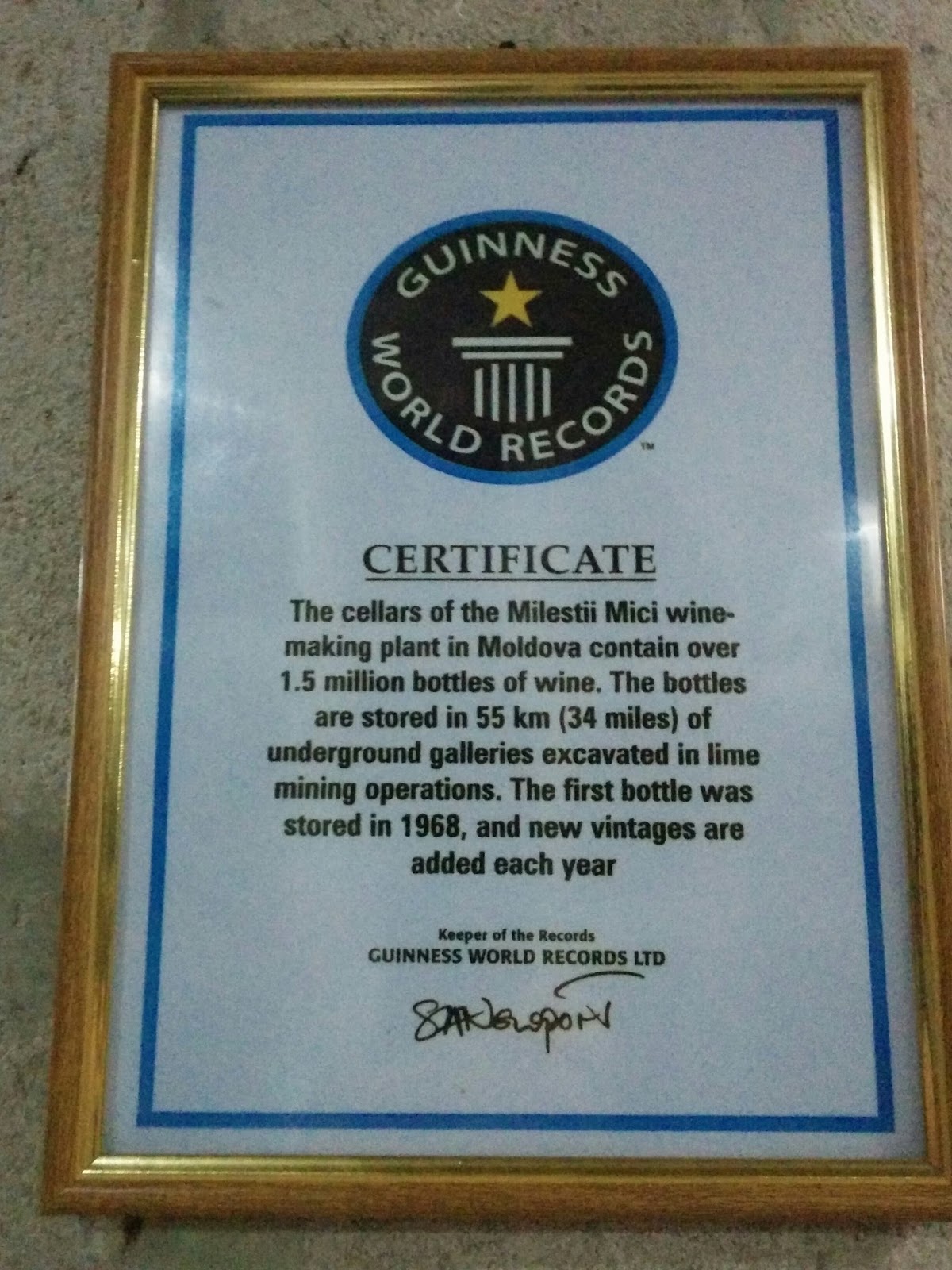
Milestii Mici Winery was founded in1969 to produce, preserve and mature high quality wines. The cellars are underground limestone galleries at a depth of 40 to 85 meters (131 to 279 feet) below the surface.  The tunnels extend for 200 kilometers (120 miles), of which only 55 kilometers (34 miles) are currently in use.  The limestone maintains a constant humidity (85 to 95% and temperature from 12 to 14 degrees C (54 to 57 degrees F) throughout the year.  These are apparently ideal conditions for storing especially some red wines which improve over time.  Some of the wines are cellared for decades before being sold.

A vehicle is required for the tour in order to travel through the underground tunnels.  The winery does not provide vehicles or have any arrangements made to hire them., and your vehicle has to have room for the tour guide to travel with you.  Since our group was too large for a taxi, we hired a rutiera for the tour.  It was a novel experience to say the least!! 

The tour takes you through several tunnel streets with names such as "Cabernet", "Shardonait", "Feteasca", "Sauvignon" etc.   There are stops to view the winery’s own source of water, an underground waterfall, tasting rooms, and cavern upon cavern of stored wines.  On a hot summer day, the cool and dark cellars were a refreshing break from the intense sunshine.  The tour provided a brief and limited view of the huge wine collection which is the pride of the winery. 

The wines stored are made from crops of various years, beginning with 1969. Grapes include Pinot, Traminer, Muscat, Riesling, Feteasca, Dnestrovscoie, Milestscoie, Codru, Negru de Purcari, Trandafirul Moldovei, Auriu, and Cahor-Ciumai, Marsala”,”Utreneaia Rosa”,”Nejnosti” etc. All are produced in strict conformity with old Moldavian traditions. Obviously some of the grape varieties are new and not native to us Americans so it would have been informative and interesting to also see the wine making process which unfortunately is not part of the tour.  

In August 2005, MileČ™tii Mici Winery was recognized by Guinness World Records as the largest wine collection by number of bottles in the world. Overall, the complex holds nearly 2 million bottles of wine. More than 70% of the stored wines are red, 20% are white and about 10% are dessert wines.  Although the dessert wine is least produced, it is actually the most expensive one. The oldest dessert wine bottles are from 1973 and are apparently priced at about $2000 USD.

Our tour ended with a tasting of three wines accompanied by snacks in one of the tasting rooms.   We tasted a red, white and desert wine.  Because we had opted for the lowest priced tour, we obviously did not taste expensive or collection wines. The red and white wines were nice table wines, but the desert wine was too sweet for my taste  We drank and ate to Moldovan folk songs played on violin and accordion by musicians dressed in traditional Moldovan costumes.  The accordionist was none other than the member of the Milestii Mici folkloric group who had entertained us at our Saturday evening event. We relaxed and enjoyed the wine, food and music!!!

Before leaving the winery we made a brief stop at the wine shop on the property.  A rather large variety of wines of different kinds and vintages is available for purchase. Unfortunately the wine shop does not ship to the US so my host family was the only beneficiary of my visit.  It was also interesting that unlike an American winery, there were limited items to buy.  The winery could definitely use some American marketing advice and expertise!!  They have an excellent facility and products, but do not really encourage visitors to buy and spend money.  This is a missed opportunity considering the struggling Moldovan economy. 

Milestii Mici wine cellar produces one million bottles per year. They export wine all around the world including Sweden, Japan, the USA, Great Britain, the Czech Republic, Poland, Greece, Germany, Denmark, Finland and China.  Before I left the USA for Moldova, I tried to find and buy a Moldovan wine, but had no success.

On the tour we learned that the winery will rent you a place in the cellars to store their wines, where conditions are best to keep wine. A renting niche costs $200 USD per year.  We saw a couple of vaults rented by persons from Russia and China.

Inasmuch as Moldova is the least visited country in Europe, the winery and its treasures are not really well known.  Yet Moldova is a “country with open doors in the paradise of wine” and all are welcome.  Wine production is a basic occupation of Moldavians. Every household in the villages makes their own wine and based upon my experiences thus far, it is mighty fine wine.

Noroc!!


Wednesday, August 5, 2015

COD Training Survey and Event

As part of our training and preparation to work with libraries, mayor's offices and NGOs, we were given an assignment to do a community survey and an event in our PST village.  The eight of us in Milestii Mici chose to work together on both projects rather than divide into two groups with one doing the survey and one doing the event.  Although we are from every region of the US and range in age from 22 to 60 plus years, we have come together as a group sharing our experiences and enjoying each other's company.

The goal of our survey was to inquire and learn whether people in the village know and/or speak English; the interest, if any, in learning English; and the level of importance the people of the village place on English as a language.  The survey was designed to be short and to the point consisting of only 6 questions. The easier the survey was to complete the better we figured were our odds of people taking part. The questions were prepared in both Romanian and Russian which are the two predominant languages in the village.  Actually planning and preparing the survey was relatively easy.  Our main concern and challenge, or so we thought, was getting people to cooperate.

On Friday, July 17, we met and went out in teams of two to locations where we knew people would gather or pass.  We waited until six o'clock in the evening when people would be coming home from work or be out and about because the day was so hot, not a person was to be found moving around the village in the afternoon.  To our surprise and delight, when we approached people, explained who were were and what we were doing, and asked them to complete the survey, we received cooperation. In less than an hour, we had almost 70 surveys completed, and only 9 people declined to participate. We definitely felt good especially since our Romanian probably was not always correct or smooth. However, the people of the village affirmed us and our only regret was that we ran out of surveys! 

Of the 70 villagers who completed the survey,  39 were male and 31 were female.  As to English proficiency, 10 indicated they were fluent, 30 were medium, 19 know a little, and 10 have no English language knowledge.  Most interesting was that 66 out of 70 responded that they were interested in learning English.  With respect to their preferences for learning the language, 50 responded that they would participate in an English class, 16 favored an English club, and 11 would like a tutor.  In sum 64 people responded that English was either very important or a priority.

Without going into all the details including all the charts and graphs we prepared for our COD presentation, the demographics also revealed that age was a factor.  The respondents ranged in age from children grouped as below 17 years of age to adults over 60 years.  There were actually 6 age categories.  What we learned was that those under 36 years of age were the ones with English knowledge, an interest in learning and a willingness to do so. The importance of English spanned all age groups.

Admittedly the survey was limited in scope and participation.  We did not have a long time and it was an exercise for training.  However, the data supports our belief that there is interest in Milestii Mici for more English language learning opportunities and that perhaps assigning a PCV to the village would be welcomed by the community.

The day after our survey, Saturday, July 18, we held our community event which was a sharing of American and Moldovan culture and sport.  With permission from and the support of the Mayor, we held our event from 6:00 to 8:00 p.m. on the field across from the school.  With equipment loaned from Peace Corps and others, we had baseballs, bats and gloves, American footballs,  a corn hole game (which we completed with children's socks filled with barley in the absence of real bean bags), and frisbees.  Of course there were soccer balls in abundance also!  Water was donated by a PCV's host brother and we PCVs chipped in to buy lots of biscuits (cookies).

Children appeared early for the event and readily got into the spirit.  Both girls and boys tried the various sports and were amazingly good at all of them!!  We appreciated that our COD PCV counterparts from Ialoveni came and joined in the clean up of the field before the games and played alongside the children and us.  Two of the PCVs spouses also attended as did another PCV.  With children,  young adults,  adults and PCVs, we had a turnout of about 70!!   

At our request the local folkloric group attended in traditional Moldovan costumes and performed several delightful songs.  Their performance ended with a huge group of locals and PCVs dancing the hora.  A good time was had by all as evidenced by the fact that people did not leave at 8:00 and it was well after 8:30 by the time we cleaned up and left the field.

The survey and event were highlights of our PST COD training.  We had fun and learned by doing. Yesterday we presented a summary and the results of both in our last PST COD training class.  We reflected on what we did well and where we need to improve.  We worked well together and supported each other.  We hopefully will also continue to be available to help each other in our individual assignments.  

The people of Milestii Mici have been wonderful and will be missed as we move on to our permanent sites.  We appreciate their kindness and support.  Below are some pictures from the event courtesy of Steve, and a link to one of the pieces performed by the folkloric group courtesy of Chris.  Enjoy!!

https://www.dropbox.com/sh/8zbato22qkxwqih/AADGXh0Kedk7VsKu5L0UkehAa?dl=0